

Blog
The Trailblazer LifeCard: Engineering Marvel or Tactical Liability?

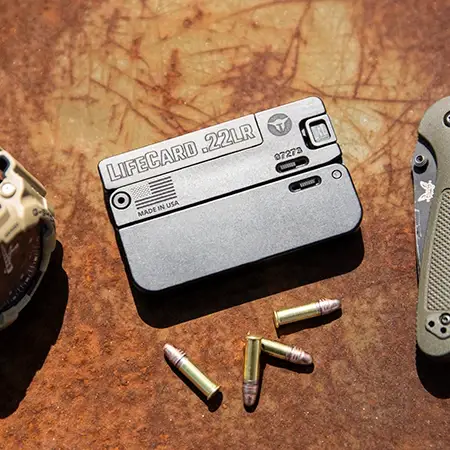
In the world of Everyday Carry (EDC), “printing”—the outline of a gun showing through clothing—is the enemy. Enter the Lifecard firearm, a weapon designed to hide in plain sight. Manufactured by Trailblazer Firearms, this folding pistol has captivated USA gun lovers since its debut.
But beyond the “James Bond” aesthetic, is the Life Card gun a viable tool for personal protection? In our analysis, we move past the hype to dissect the mechanics, the ballistics, and the cold hard reality of carrying a single-shot credit card gun.
What is the LifeCard?
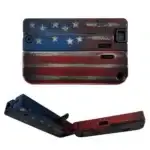
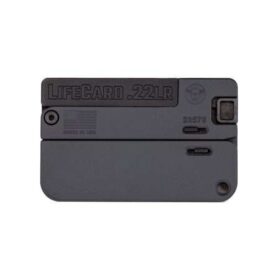
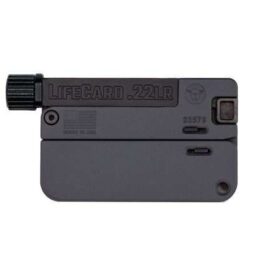
The LifeCard is a folding, single-shot pistol constructed from machined aluminum (handle) and steel (barrel/bolt). When collapsed, it is roughly the size of a stack of credit cards.
Specifications (LifeCard .22 LR):
- Length (Folded): 3.375 inches
- Height (Folded): 2.125 inches
- Thickness: 0.5 inches
- Weight: ~7 ounces
- Capacity: 1 round (plus storage for extra rounds in the handle)
It is technically classified as a pistol, not an AOW (Any Other Weapon), meaning it does not require a tax stamp from the ATF to own in most states.
LifeCard Caliber Options
Currently, Trailblazer offers the Lifecard Trailblazer in two primary rimfire calibers:
- LifeCard 22 LR: The standard model. Low recoil, cheap ammo, but limited stopping power.
- LifeCard .22 WMR (Magnum): Offers significantly higher velocity and penetration than the LR version, making it a more viable defensive option.
The “9mm LifeCard” Myth and the Trailblazer Pivot
Does a Life Card gun 9mm exist?
No. There is no LifeCard chambered in 9mm.
This is a common confusion in the firearms community. The LifeCard’s frame is too small to handle the pressure of a centerfire 9mm cartridge.
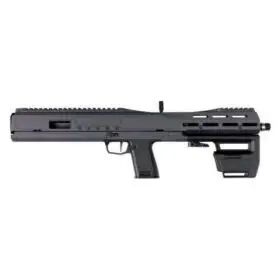
However, Trailblazer Firearms does manufacture a 9mm folding pistol known as the Trailblazer Pivot (or Trailblazer Firearms Pivot). The Pivot uses a unique rotating mechanism to unfold, takes Glock magazines, and is a full-sized firearm compared to the miniature Lifecard 22. If you are looking for a “folding 9mm,” the Pivot is the gun you are searching for, not the LifeCard.
Deployment and Mechanics: The Speed Analysis
How fast can you shoot a LifeCard?
In our testing, the average time to draw, unfold, cock, and fire the LifeCard is between 3 to 5 seconds.
This is the critical “Information Gain” analysis that separates this review from generic product descriptions.
The Deployment Sequence
Unlike a Glock or a Smith & Wesson J-Frame, the Life Card pistol requires fine motor skills to operate.
- Retrieve: Pull from pocket (or specialized holster).
- Unlock: Actuate the sliding latches to unfold the grip.
- Cock: Pull the bolt back (it is single-action only).
- Fire: Squeeze the trigger.
The Tactical Reality
The “Tueller Drill” suggests an attacker can cover 21 feet in 1.5 seconds. Because the Lifecard 22lr takes nearly 4 seconds to deploy, it fails the primary requirement for a reactionary self-defense weapon.
Our Verdict: The Life Card 22 should not be your primary EDC. It is a “Get Off Me” gun or a deep-cover backup for non-permissive environments where carrying a standard firearm is impossible.
Ballistics: .22 LR vs .22 WMR
When choosing between the Lifecard 22 lr and the Lifecard 22 mag, ballistics matter.
.22 LR (Long Rifle)
The Lifecard 22lr is a plinker. Out of the short barrel, velocities are low. It will penetrate, but it lacks the hydrostatic shock required to incapacitate an attacker reliably without precise shot placement.
.22 WMR (Winchester Magnum Rimfire)
The Lifecard 22 wmr is the superior choice for defense. The .22 Mag cartridge achieves higher velocities and creates a larger temporary wound cavity. If you are buying this as a backup wallet gun, we strongly recommend the WMR version over the Lifecard 22.
LifeCard Price Breakdown
How much does a Lifecard gun cost?
The Lifecard 22 price in USA typically sits between $299 for the .22 LR model and $340 for the .22 WMR model.
Retailers often fluctuate prices based on demand and finish (options include Black, FDE, and Sniper Gray).
| Model | Average MSRP | Street Price |
|---|---|---|
| LifeCard .22 LR | $320 | $289 – $310 |
| LifeCard .22 WMR | $340 | $310 – $350 |
| Trailblazer Pivot (9mm) | $1,795 | $1,500 – $1,700 |
Note: The Lifecard 22 cost is significantly lower than the Trailblazer Pivot, reflecting the difference in engineering complexity between a single-shot rimfire and a semi-auto centerfire.
Pros and Cons: A Buyer’s Framework
To help you decide if the Lifecard firearm belongs in your safe, we’ve broken down the advantages and disadvantages.
Pros
- Ultimate Concealment: It is the only gun that effectively disappears in a shirt pocket or minimalist wallet pouch.
- Talking Piece: It is undeniably cool. As a piece of engineering, it impresses everyone at the range.
- Storage: The handle stores up to 4 extra rounds of 22 lifecard ammo.
- Safety: Because it cannot fire when folded and requires manual cocking, it is inherently safe against negligent discharges while in a pocket.
Cons
- Slow Deployment: Unfolding and cocking takes too long for sudden altercations.
- Capacity: You have one shot. Reloading requires breaking the barrel open, removing the spent casing manually, and inserting a new round.
- Sights: The “sights” are merely a groove along the top of the barrel. Accuracy beyond 5-7 yards is difficult.
- Ergonomics: The flat, rectangular grip is uncomfortable for extended shooting sessions.
Comparison Table: LifeCard vs. North American Arms (NAA) Pug
The closest competitor to the life card guns is the North American Arms mini-revolver.
| Feature | Trailblazer LifeCard | NAA Pug (.22 Mag) |
|---|---|---|
| Profile | Flat, rectangular (no printing) | Cylinder bulge (slight print) |
| Capacity | 1 Round | 5 Rounds |
| Action | Single Shot (Break Action) | Single Action Revolver |
| Deployment | Slow (Unfold + Cock) | Medium (Cock hammer only) |
| Caliber | .22 LR / .22 WMR | .22 LR / .22 WMR |
| Price | ~$300 | ~$350 |
Winner: For pure concealment, the LifeCard wins. For shootability and capacity, the NAA Pug wins.
Glossary of Terms
- AOW (Any Other Weapon): A category of NFA firearms. While “pen guns” are often AOWs requiring a tax stamp, the LifeCard is not, because it must be unfolded to fire, resembling a standard pistol shape.
- Rimfire: A type of ammunition (like .22 LR) where the primer is contained in the rim of the cartridge base, rather than a central primer cap.
- Single-Action: A trigger mechanism where the hammer or bolt must be manually cocked before the trigger can release it.
- Printing: Visible outlines of a firearm through clothing.
- WMR: Winchester Magnum Rimfire, often called “.22 Mag.”
Frequently Asked Questions (FAQ)
Is the LifeCard legal in California?
As of this writing, the Lifecard trailblazer is not on the California Handgun Roster, meaning it cannot be sold new by dealers to civilians in California. However, laws change frequently; check local DOJ listings.
Is the LifeCard considered a switchblade gun?
No. It does not deploy via a spring button. It is a manual folder. This distinction is important for legal classification.
Can I carry the LifeCard in my wallet?
While it is the size of a credit card stack, it is too thick (0.5 inches) for a standard leather billfold. It fits best in an Altoids tin, a dedicated Kydex sheath, or loose in a pocket.
Is there a Life Card gun 9mm price?
Since the LifeCard does not exist in 9mm, there is no price. However, the Trailblazer Firearms Pivot (which is 9mm) costs approximately $1,795.
What is the difference between Lifecard 22 and Lifecard 22 WMR?
The physical dimensions are identical. The only difference is the chambering and barrel pressure tolerance. The WMR version is slightly louder and offers better ballistic performance.
Disclaimer: Firearm laws vary by state and municipality. Always verify local regulations regarding concealed carry and firearm ownership before purchasing.
